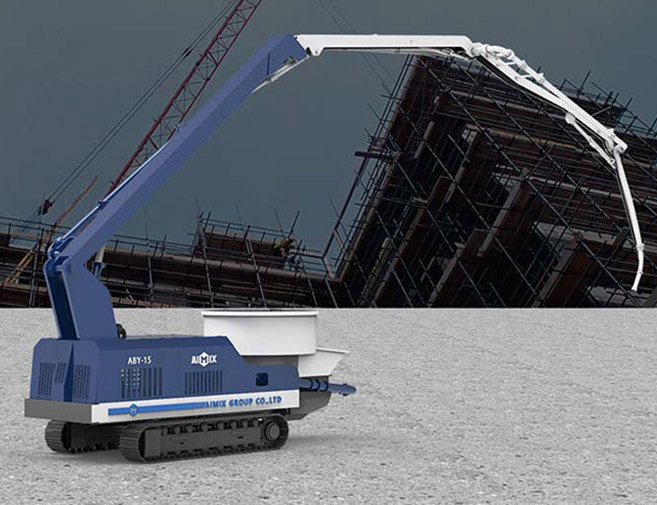
The crawler boom concrete pump occupies a unique and valuable niche in the construction equipment spectrum. Neither a simple line pump nor a standard truck-mounted unit, it combines the terrain-conquering mobility of tracked propulsion with the precise placement capability of an articulating boom. This specialization commands a significant price premium. However, the pricing trajectory of these sophisticated machines is not immutable. It is subject to distinct, identifiable pressures emanating from technology, regulation, and market structure. Predicting prices for 2026 and beyond requires moving beyond simple inflation indexing to analyze the specific vectors that will compress or expand the cost of these assets. This analysis contends that the coming years will witness a fundamental repricing of crawler boom pumps for sale, driven not by uniform cost increases but by a structural bifurcation of the market into distinct price-performance tiers, altering procurement strategy for contractors worldwide.
The Technology and Regulation Vector: Cost-Inflating Forces
The first and most predictable set of pressures will push baseline prices upward. These are not optional enhancements but mandated adaptations to evolving technical and environmental standards.
Emissions Compliance and Powertrain Evolution
The internal combustion engine, still the dominant power source for crawler pumps, is undergoing its most significant transformation in a century. Tier 4 Final emissions standards, already enforced in North America and Europe, are progressively becoming the baseline expectation in major export markets, including the Middle East, Southeast Asia, and parts of Africa. The engineering required to achieve these standards—common-rail fuel injection, cooled exhaust gas recirculation, diesel particulate filters, and selective catalytic reduction systems—adds significant cost to the engine package. A Tier 4 Final compliant diesel engine costs approximately 30-40% more than its Tier 3 predecessor. By 2026, manufacturers offering non-compliant engines will face increasing export restrictions and buyer resistance, effectively mandating this cost pass-through. Furthermore, the early-stage commercialization of fully electric crawler cement mixer with pump, while still confined to niche applications and indoor use, will establish a new, higher price ceiling. These units, incorporating large battery packs and electric drivetrains, will command premiums of 50-100% over diesel equivalents, serving as a technological flagship that re-anchors perceptions of upper-tier pricing.
Intelligent Systems and Autonomous Capability Integration
The second major cost-inflating vector is the integration of advanced control and telemetry systems. What was once optional is becoming implicit. Buyers increasingly expect real-time machine telemetry, remote diagnostics, GPS positioning, and boom stability monitoring as standard equipment. The hardware and software engineering required for this connectivity is substantial. Moreover, the emergence of semi-autonomous boom control systems—which assist operators in precise placement through joystick commands and pre-programmed movements—adds another layer of sensor and control system cost. These systems are not cosmetic; they demonstrably improve placement accuracy, reduce operator fatigue, and prevent collisions. By 2026, a crawler pump without comprehensive telematics and advanced control features will be perceived as technologically obsolete, forcing manufacturers to incorporate these costs into their baseline specifications and, consequently, their prices.
Market Structure and Supply Dynamics: Divergent Price Pressures
While technology and regulation exert uniform upward pressure, market structure forces are creating divergent trajectories. The crawler pump market is bifurcating, and pricing will follow.
The Premium Tier: German and Italian Engineering Persistence
European manufacturers, principally German and Italian, have long defined the premium segment of the crawler pump market. Brands such as Putzmeister, Schwing, and Cifa have cultivated reputations for engineering excellence, component longevity, and comprehensive support networks. These manufacturers will continue to pursue a high-price, high-value strategy. Their pricing will increase at rates exceeding general inflation, justified by continuous incremental refinement, superior residual values, and the intangible but commercially valuable asset of brand trust. For contractors operating in highly regulated markets, on critical infrastructure projects, or with zero-tolerance downtime policies, this premium remains justifiable. The price gap between this tier and the rest will likely widen, not narrow.
The Value Tier: Chinese Manufacturing at Scale
Simultaneously, Chinese manufacturers have decisively entered the crawler concrete pump machine segment. Unlike their entry into simpler equipment categories decades ago, this incursion is not based solely on imitation and low labor cost. Leading Chinese OEMs have achieved significant engineering competence, often through technology transfer partnerships with former European industry leaders. They now manufacture crawler pumps with component provenance—hydraulics, engines, controllers—indistinguishable from mid-tier global suppliers. Their scale of production, serving both a vast domestic market and international exports, confers structural cost advantages that European competitors cannot replicate. Consequently, Chinese manufacturers will continue to offer crawler pumps at price points 30-50% below European equivalents while progressively closing the performance and reliability gap. By 2026, this tier will represent the rational economic choice for the majority of commercial, residential, and even many infrastructure projects globally, exerting powerful downward pressure on volume-weighted average pricing.
Procurement Strategy in a Bifurcated Market: Price Prediction Synthesis
Synthesizing these vectors yields a nuanced price forecast. The era of a single, referenceable price for a “crawler boom concrete pump” is ending. Buyers will face a structured market with distinct bands.
Tiered Pricing Architecture: 2026 Projections
The entry-level/value tier, dominated by Chinese manufacturers with standard component specifications and basic telematics, will see minimal real price increases. Intense competition among multiple capable suppliers will suppress margin expansion. A 28-32 meter class machine in this tier is projected to maintain pricing in the range of $180,000 to $230,000, with modest adjustments for raw material inflation and emissions compliance.
The mid-tier, comprising established Asian brands and Chinese manufacturers offering premium component upgrades (European engines, advanced control systems), will see prices in the $250,000 to $320,000 range. This tier represents the optimal balance of capability and cost for most serious contractors.
The premium tier, exclusively European, will continue its upward trajectory. A 32-meter class machine from a leading German manufacturer, equipped with full telematics, advanced boom control, and Tier 4 Final compliance, will command prices exceeding $450,000, potentially approaching $500,000. This tier serves the segment of the market for whom absolute reliability and brand heritage justify a cost structure detached from volume-driven economics.
Strategic Implications for Buyers and Suppliers
For buyers, this bifurcation demands a more sophisticated procurement approach. The decision is no longer “which crawler pump should I buy?” but “which tier of crawler pump capability and support does my business model require?” Contractors must honestly assess their tolerance for downtime, their access to technical support, and their clients’ willingness to pay for the assurance that premium brands confer. For suppliers, particularly those in the value tier, the imperative is to continue closing the perception gap. Demonstrated reliability, transparent warranties, and localized parts inventory will be the battlegrounds. Boom concrete mixer pump price alone will not sustain market share once the initial conversion from European brands is complete.
In conclusion, the future pricing of crawler boom concrete pumps will be characterized not by uniform increases but by structural stratification. Technology and regulation will elevate the ceiling. Industrial scale and engineering maturation will elevate the floor while simultaneously creating a vast, capable middle market. The buyer who navigates this landscape successfully will be the one who understands that price is no longer a single data point, but a complex signal of machine capability, component provenance, brand commitment, and market positioning—a signal requiring increasingly sophisticated interpretation.